The road trip gang (Moses, Themba, Babalwa and Bestos) is back together again...this time for a trip to the largest township in South Africa, i.e. Soweto. For those who are unfamiliar with Soweto, it is known for many things but most prominently:
1. it was the site of a mass uprising in 1976 due to the then-government's policy that school would be taught in Afrikaans instead of English although that was more of a tipping point given all of the other oppressive policies. The police opted to shoot at the protesters which included many high school students resulting in the deaths of 23 people; and
2. it was the home of Nelson Mandela and his family for many years.
Our first stop was the Emdeni Skills Development Center. And once again I was impressed by the creativity employed by the organizations trying to help develop community member's skills in order to address the unemployment problem. The SDC offers a myriad of programs to give people practical skills so they can find employment. In addition to the Siyafunda based IT skills and training, it has counselling by trained social workers, a drop in center so teens can be fed and get help with their homework, assistant chef classes including practical training in a small kitchen, small business skills training, and contractor/renovation training. And for some programs, there are even placements to give the students experience for example, internships at a food preparation company.
The poor students had to put up with having their classes crashed by the "visitor from Canada" but they were all quite gracious about the interruption. With all of the good things that CDC is making available to students, they are still struggling with space constraints as each class was overflowing with students.
My favorite class at the Emdeni SDC was the agricultural class. The property at the back of the building is filled with small greenhouses so that the students can learn to grow vegetables on their own. Several of the students have even started small businesses selling the produce they have independently grown. One student was kind enough to give me a tour of her greenhouse and it was the healthiest looking spinach I ever saw. She wanted me to take some with me to Canada but I had to explain that importation of vegetables from Africa may not make me popular at Customs.
Our next stop would be a small residential home for people with physical disabilities. So that we wouldn't get lost (and remember Soweto is the largest township with narrow and winding streets), one of the CKC trainers based in Soweto rode with us from Emdeni to the next stop. We piled into the car like a VW commercial. Who knew six could fit in a Corolla?
It was about this time that had my first sighting of Western Union when a mini bus taxi drove by fully branded in black and yellow. I tried to get a shot but those taxis drive pretty past and we couldn't keep up.
Isaac at the residential center gave us a quick tour of the premises. The center has six full time residents and operates a center in the home for people to use the computers and obtain skills training. I had a long chat with the two managers of the center and they gave me a fairly good picture of the challenges they face particularly in the face of little funding and a shortage for services for community members with physical challenges.
It was about this time that we heard that the government had agreed to freeze university tuition and to retract the tuition hikes. Amazing what the students were able to accomplish by banding together. There are of course still a component of students who would like the government to offer free tertiary education as was promised in the past so it is possible that protests will continue.
Given that it's now Friday afternoon and it's been a long week, we decided to call it an early day at about 3 and do some sightseeing and grab a bite. We contemplated going bungee jumping which I have never done but I didn't want to risk not being able to finish my project with Siyafunda due to an early expiry. So instead we chose a more meaningful option and we went to Mandela House where Nelson Mandela lived until 1962 when he was imprisoned. He eventually returned there when he was released from prison. You can see the bullet holes and fire bomb scorch marks on the exterior of the building. The original building had a brick wall inside in the center so that the family would not get shot when bullets came in through the window facing the tree however the wall is no longer there. The story of the Mandelas is a familiar one to most and it is hard to comprehend how much he accomplished in his lifetime at great personal cost. It is also impossible not to wonder what he would think about the current state of politics in South AFrica given the rates of unemployment and the fact that in many ways the effects of apartheid are still evident on every corner.
After our tour, we wrapped up our day with a bite to eat at a restaurant in Soweto and off we all went to start our weekends.
Monday, October 26, 2015
Day 4 - Shift in Gear
The student Fees Must Fall demonstrations continue with force in South Africa today and the universities are largely shut down. It is the primary news item 24/7 as the police have used stun grenades, water cannons and arrests to address the students protesting and marching. There are concerns that the violence will continue to ratchet up. The general population are largely supportive of the students and understand the frustrations with the government. Due to concerns about bystanders getting caught in the fray, the routes of the protests are publicized so that folks can avoid the areas if they wish to although many want to join in due to frustrations about unkept promises made by the government.
Today was a significant shift in gear from the road trip of yesterday although no less productive!
In addition to the hard work and entrepreneurship of Smiley, the CKC managers and staff and the multiple partners operating their own centers, the growth of Siyafunda is also attributable to the contributions made by Siyafunda's key corporate partners. Both Cisco and Intel provide corporate funding and the content and training for the courses ultimately offered by Siyafunda and the CKC's to the community. Today we met with both of these partners who were gracious enough to listen to the details of the project we are working on as part of the Ashoka Executive in Residence program. It was evident that both companies are committed to helping the communities and that they have chosen to work with Siyafunda due to their trust in the organization and because of the impact that Siyafunda has had. Alfie at Cisco and the team at Intel also seem invested in continuing to develop the systems used by organizations such as Siyafunda including developing online training courses for use by persons with physical challenges.
Meeting with Alfie Hamid at Cisco
What really stood out to me about Cisco and Intel is that they do not consider their contribution to be limited to funding or developing IT and other skill training courses. It was clear that they are both keen to contribute to bettering the unemployment situation in South Africa. It is also clear that they do not just contribute funds to Siyafunda but that they are intimately familiar with the details of the organization and its operations. Cisco in particular worked with Siyafunda closely on a project not dissimilar to what I am working on. In fact, along with some other organizations, they helped develop the idea of transitioning Siyafunda centers from CTC's (community technology centers) to CKC's (community knowledge center) in order to help expand the breadth of services to encompass more than just technology training.
Meeting with Thabani Khupe, Ruala and Suraj Shah at Intel
I was heartened to see large companies such as Cisco and Intel truly taking an active part in supporting the local communities.
Now that the camera is up and running again, I have also attached some of the additional photos from the road trip yesterday.
Today was a significant shift in gear from the road trip of yesterday although no less productive!
In addition to the hard work and entrepreneurship of Smiley, the CKC managers and staff and the multiple partners operating their own centers, the growth of Siyafunda is also attributable to the contributions made by Siyafunda's key corporate partners. Both Cisco and Intel provide corporate funding and the content and training for the courses ultimately offered by Siyafunda and the CKC's to the community. Today we met with both of these partners who were gracious enough to listen to the details of the project we are working on as part of the Ashoka Executive in Residence program. It was evident that both companies are committed to helping the communities and that they have chosen to work with Siyafunda due to their trust in the organization and because of the impact that Siyafunda has had. Alfie at Cisco and the team at Intel also seem invested in continuing to develop the systems used by organizations such as Siyafunda including developing online training courses for use by persons with physical challenges.
Meeting with Alfie Hamid at Cisco
What really stood out to me about Cisco and Intel is that they do not consider their contribution to be limited to funding or developing IT and other skill training courses. It was clear that they are both keen to contribute to bettering the unemployment situation in South Africa. It is also clear that they do not just contribute funds to Siyafunda but that they are intimately familiar with the details of the organization and its operations. Cisco in particular worked with Siyafunda closely on a project not dissimilar to what I am working on. In fact, along with some other organizations, they helped develop the idea of transitioning Siyafunda centers from CTC's (community technology centers) to CKC's (community knowledge center) in order to help expand the breadth of services to encompass more than just technology training.
Meeting with Thabani Khupe, Ruala and Suraj Shah at Intel
I was heartened to see large companies such as Cisco and Intel truly taking an active part in supporting the local communities.
Now that the camera is up and running again, I have also attached some of the additional photos from the road trip yesterday.
Thursday, October 22, 2015
Day 3 - Road Tripping!
It is difficult to adequately capture yesterday with words or even photos. For one, I went on an 8 1/2 hour road trip which felt like it was two days of life experience packed into one. And, I was overwhelmed by the magnitude of hardship faced by the local communities but more so by the magnitude of people's goodwill and selfless generosity.
On the way to the Palm Ridge CKC today, I realized that the number of people I had seen waiting on the side of the road each morning were not waiting for the most commonly used mode of transportation, the mini-bus taxis. They were unemployed folks (many foreign immigrants) who sit on the side of the road in the hot sun waiting to see if someone that day has a need for temporary (and probably under minimum wage) labourers. While the policies of apartheid including those which forced segregated transportation, cemeteries, schools and residential areas (to the point of forced re-settlements of non-white communities to accomplish residential segregation) are in the past, it is apparently a long road (not yet travelled) to unwind the effects of these policies.
I set off on a road trip with my travel companions Babalwa, Moses, Bestos and Themba at 930 am from Palm Ridge so I could see more of the CKC's and CKC partners.
First stop: the Thokoza CKC managed by Puleng. We drove in on the infamous Kumalho Street which was a key battleground during the severe political violence which occurred in the early 90's and which lead to the deaths of many people in the township. While the political violence has ended, the township is still rife with people living in "temporary houses". Small businesses like hairdressers and food providers are operating from some of the temporary structures.
The Thokoza CKC shares its building with the Fab Lab (Fabrication Lab) which is operated by the municipality.
The CKC offers administrative services (printing, faxing, scanning) and also the ICT and skills training courses. The Fab Lab offers the ability to use computer programs to generate images for 3D printing or wood products. Since I had never seen a 3D printer in action or a ShopBot ever, I was fascinated by the technology.
Results of 3D printing and etching. Shout out to my Englewood colleagues: modelling provided by Bestos and Babalwa
ShopBot
It did seem odd to me though that although there is a lack of basis computer use skills, there are machines available for 3D printing. Unfortunately, the municipality has decided to offer the same services offered by the CKC and has asked Puleng to close up shop by the end of the year. She has not yet found a replacement location for the Thokoza CKC.
Photo with Poleng (green shirt), the staff and some of the CKC students who we dragged from their computers for a photo op
Second stop: We next accompanied Bestos to the Alok Tele-Center (which is partnered with Siyafunda) so he could address some IT hardware issues they were having. Alok itself is a Thokoza community organization which offers IT skill training courses but also is a forum for community awareness events addressing all types of issues including HIV/AIDS prevention, domestic abuse, and substance abuse.
Bestos and Themba
Third stop: Before we left Thokoza, Themba had to attend at the Tshepong Stimulation Center for Intellectually Disabled Children. Tshepong has asked Siyafunda to help roll out certain basic IT and administrative skills to developmentally challenged adults at a location outside of Thokoza so that they can learn to answer phones and make appointments. This is an interesting project for Siyafunda and the CKC's as it will be a first time foray into this space. On an important side note, in addition to programs relating to education the unemployed and poor disadvantaged women and girls, Siyafunda is already involved or piloting programs for disseminating IT training to those with hearing or sight impairments and to those incarcerated in prison.
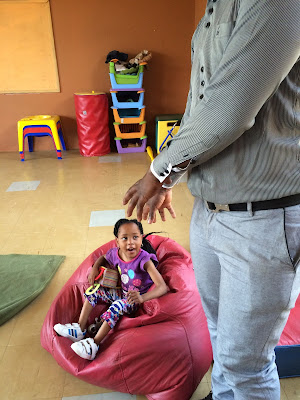
Before we arrived at Tshepong someone jokingly asked me if I cry easily. By the time we left, I understood why the question was asked. Tshepong in Thokoza takes care of children with varying degrees of cerebral palsy. There are approximately 50 children being looked after each day at the center of which only about 6 reside there. The rest get picked up and dropped off daily in the one van that Tshepong has. For the 50 children, there are very few staff who work for a salary that does amount to enough to subsist on. There is a two to five ratio for the children with the most severe conditions who cannot even move by themselves. We spend along time at the Center mostly because none of us wanted to leave that quickly. We were introduced to all of the staff and social workers and spent time in each room with the very adorable kids. The little 4 year old who couldn't walk 6 months ago but who proudly showed off her ability to walk with assistance. The little boy who had started to progress to walking at the Center before his parents decided that traditional medicine would be of more use to him. He is now back at the Center but has significantly regressed so that the rehabilitation must start again from the beginning. The kids who can't move at all or can only slightly move their limbs. But most of them were so happy to see us or, with the shyer ones, interested that we were there. Most wanted physical contact and I haven't had that many hugs since...ever. In fact, in photos you can see the before and after state of my hair attributable to the little boy who literally jumped into my arms and thought it was tremendous fun to do a re-style.
An American woman donated sufficient funds to the Center so that they could renovate a part of the building for residential purposes. The majority of the new cribs stand ready but un-used because there simply are not enough staff to look after that many children 24/7.
It wasn't just the kids and the challenges they face that was the most heart wrenching part of the visit. It was also that these individuals opt to lovingly take care of these kids out of nothing more than their kindness and passion for doing good and making a difference. Again, they get paid almost nothing and the manager has to apply each year to private corporate funders to generate enough money to even pay them a bonus. Some years he can and some years he can't. By the time we left, a few of us teary-eyed, had thoughts about leaving our jobs to join the staff at Tshepong.
This is roughly the time when my phone ran out of juice.
Fourth stop: Next stop was the township of Katlehong to another partner of Siyafunda which operates a web access site and a job posting access site as part of a program called Lulaway. Those interested in jobs can work on their resumes and get help uploading their resumes to a central job search engine. What was most interesting about the site was that in addition to the multiple NGO organizations housed there, there is also the church housed by a tent which has been unofficially occupying the space for years.
Fifth stop: After we left Katlehong, we drove to Ratanda in Heidelberg which is a rural community. There was a vast difference in feel between the townships closer to the city and Ratanda and there are few transportation channels to get there. The road as we neared Ratanda was primarily filled with two kinds of residences: government housing but even more temporary housing.
Government Housing
Temporary "Housing"
Local community residents have waited for many many years to be granted permanent housing and there are theories as to who is able to get the privileged access to the permanent housing. The staff at Rotonda, like Sara Emily who started out as a student of the CKC and now works there (as is the story with several of the staff), were so friendly and gracious and have grown so quickly that they have expanded to a separate building. Only a few years ago, the entire CKC, the municipal properties around it and the area of Ratanda at large was literally set on fire during violent protests. Sadly, the CKC was destroyed. Moses, the CKC manager, and the other staff rebuilt the CKC themselves as it would have taken too long to wait for insurance proceeds and other bureaucratic process to kick in. When I asked him what he did in the time that the CKC was destroyed, he told me he was strategizing as to how to rebuild it because it wasn't right to have taken people's money for IT learning courses and not be providing them a service.
The day had not yet ended.
Sixth stop: the community "Drop In" which Moses works with in his "spare" time. The Drop in is a local center where orphans and vulnerable children come each day to be fed two square meals, have their clothes laundered and to get help with their homework. The point is to keep these kids off the streets and away from the rampant drug and crime problem and make sure they are looked after since they don't have families who are able to. The center was kind enough to give us a tour. There were at least 100 kids in the center all patiently waiting for their meals which get served to them by a staff of all volunteers. Once again, the passion of certain people to dedicate their time and lives to looking after vulnerable kids has amazed me. The size of the crock pot and oven in the kitchen also amazed me.
Seventh stop: Before we leave Ratanda, Moses asks if we can stop at SANCA headquarters. SANCA is the South African National Council on Alcoholism and Drug Dependence where he used to work because he wanted me to meet his prior boss. Suzette spent some time with us explaining the tall order they address on a daily basis across the country. In addition to prevention education, they operate outpatient clinics for people with severe drug abuse problems. Drug use is a rampant problem in the townships and there are insufficient in patient programs to help those who are trying to get off of the most serious drugs. It is no surprise that the crime rate is so high.
End of the Day: Many hours after we started our trip, we drove back to my guesthouse mentally exhausted and overwhelmed by the day's events. It was a tremendous day on so many levels and Moses, Bestos, Themba and Babalwa shared with me so many insights about the country and their personal lives. They are all very unique people who themselves do so much to contribute to problem solving and helping in their communities and i can see the impacts each of them have made as I spend more time at the Centers and with them. We had such a good time that Bestos and Themba are re-arranging their schedules on Friday so that they can join Moses, Babalwa and I on our trip to Soweto.
On the way to the Palm Ridge CKC today, I realized that the number of people I had seen waiting on the side of the road each morning were not waiting for the most commonly used mode of transportation, the mini-bus taxis. They were unemployed folks (many foreign immigrants) who sit on the side of the road in the hot sun waiting to see if someone that day has a need for temporary (and probably under minimum wage) labourers. While the policies of apartheid including those which forced segregated transportation, cemeteries, schools and residential areas (to the point of forced re-settlements of non-white communities to accomplish residential segregation) are in the past, it is apparently a long road (not yet travelled) to unwind the effects of these policies.
I set off on a road trip with my travel companions Babalwa, Moses, Bestos and Themba at 930 am from Palm Ridge so I could see more of the CKC's and CKC partners.
First stop: the Thokoza CKC managed by Puleng. We drove in on the infamous Kumalho Street which was a key battleground during the severe political violence which occurred in the early 90's and which lead to the deaths of many people in the township. While the political violence has ended, the township is still rife with people living in "temporary houses". Small businesses like hairdressers and food providers are operating from some of the temporary structures.
The Thokoza CKC shares its building with the Fab Lab (Fabrication Lab) which is operated by the municipality.
The CKC offers administrative services (printing, faxing, scanning) and also the ICT and skills training courses. The Fab Lab offers the ability to use computer programs to generate images for 3D printing or wood products. Since I had never seen a 3D printer in action or a ShopBot ever, I was fascinated by the technology.
Results of 3D printing and etching. Shout out to my Englewood colleagues: modelling provided by Bestos and Babalwa
ShopBot
It did seem odd to me though that although there is a lack of basis computer use skills, there are machines available for 3D printing. Unfortunately, the municipality has decided to offer the same services offered by the CKC and has asked Puleng to close up shop by the end of the year. She has not yet found a replacement location for the Thokoza CKC.
Photo with Poleng (green shirt), the staff and some of the CKC students who we dragged from their computers for a photo op
Second stop: We next accompanied Bestos to the Alok Tele-Center (which is partnered with Siyafunda) so he could address some IT hardware issues they were having. Alok itself is a Thokoza community organization which offers IT skill training courses but also is a forum for community awareness events addressing all types of issues including HIV/AIDS prevention, domestic abuse, and substance abuse.
Bestos and Themba
Third stop: Before we left Thokoza, Themba had to attend at the Tshepong Stimulation Center for Intellectually Disabled Children. Tshepong has asked Siyafunda to help roll out certain basic IT and administrative skills to developmentally challenged adults at a location outside of Thokoza so that they can learn to answer phones and make appointments. This is an interesting project for Siyafunda and the CKC's as it will be a first time foray into this space. On an important side note, in addition to programs relating to education the unemployed and poor disadvantaged women and girls, Siyafunda is already involved or piloting programs for disseminating IT training to those with hearing or sight impairments and to those incarcerated in prison.
Before we arrived at Tshepong someone jokingly asked me if I cry easily. By the time we left, I understood why the question was asked. Tshepong in Thokoza takes care of children with varying degrees of cerebral palsy. There are approximately 50 children being looked after each day at the center of which only about 6 reside there. The rest get picked up and dropped off daily in the one van that Tshepong has. For the 50 children, there are very few staff who work for a salary that does amount to enough to subsist on. There is a two to five ratio for the children with the most severe conditions who cannot even move by themselves. We spend along time at the Center mostly because none of us wanted to leave that quickly. We were introduced to all of the staff and social workers and spent time in each room with the very adorable kids. The little 4 year old who couldn't walk 6 months ago but who proudly showed off her ability to walk with assistance. The little boy who had started to progress to walking at the Center before his parents decided that traditional medicine would be of more use to him. He is now back at the Center but has significantly regressed so that the rehabilitation must start again from the beginning. The kids who can't move at all or can only slightly move their limbs. But most of them were so happy to see us or, with the shyer ones, interested that we were there. Most wanted physical contact and I haven't had that many hugs since...ever. In fact, in photos you can see the before and after state of my hair attributable to the little boy who literally jumped into my arms and thought it was tremendous fun to do a re-style.
An American woman donated sufficient funds to the Center so that they could renovate a part of the building for residential purposes. The majority of the new cribs stand ready but un-used because there simply are not enough staff to look after that many children 24/7.
It wasn't just the kids and the challenges they face that was the most heart wrenching part of the visit. It was also that these individuals opt to lovingly take care of these kids out of nothing more than their kindness and passion for doing good and making a difference. Again, they get paid almost nothing and the manager has to apply each year to private corporate funders to generate enough money to even pay them a bonus. Some years he can and some years he can't. By the time we left, a few of us teary-eyed, had thoughts about leaving our jobs to join the staff at Tshepong.
This is roughly the time when my phone ran out of juice.
Fourth stop: Next stop was the township of Katlehong to another partner of Siyafunda which operates a web access site and a job posting access site as part of a program called Lulaway. Those interested in jobs can work on their resumes and get help uploading their resumes to a central job search engine. What was most interesting about the site was that in addition to the multiple NGO organizations housed there, there is also the church housed by a tent which has been unofficially occupying the space for years.
Fifth stop: After we left Katlehong, we drove to Ratanda in Heidelberg which is a rural community. There was a vast difference in feel between the townships closer to the city and Ratanda and there are few transportation channels to get there. The road as we neared Ratanda was primarily filled with two kinds of residences: government housing but even more temporary housing.
Government Housing
Temporary "Housing"
Local community residents have waited for many many years to be granted permanent housing and there are theories as to who is able to get the privileged access to the permanent housing. The staff at Rotonda, like Sara Emily who started out as a student of the CKC and now works there (as is the story with several of the staff), were so friendly and gracious and have grown so quickly that they have expanded to a separate building. Only a few years ago, the entire CKC, the municipal properties around it and the area of Ratanda at large was literally set on fire during violent protests. Sadly, the CKC was destroyed. Moses, the CKC manager, and the other staff rebuilt the CKC themselves as it would have taken too long to wait for insurance proceeds and other bureaucratic process to kick in. When I asked him what he did in the time that the CKC was destroyed, he told me he was strategizing as to how to rebuild it because it wasn't right to have taken people's money for IT learning courses and not be providing them a service.
The day had not yet ended.
Sixth stop: the community "Drop In" which Moses works with in his "spare" time. The Drop in is a local center where orphans and vulnerable children come each day to be fed two square meals, have their clothes laundered and to get help with their homework. The point is to keep these kids off the streets and away from the rampant drug and crime problem and make sure they are looked after since they don't have families who are able to. The center was kind enough to give us a tour. There were at least 100 kids in the center all patiently waiting for their meals which get served to them by a staff of all volunteers. Once again, the passion of certain people to dedicate their time and lives to looking after vulnerable kids has amazed me. The size of the crock pot and oven in the kitchen also amazed me.
Seventh stop: Before we leave Ratanda, Moses asks if we can stop at SANCA headquarters. SANCA is the South African National Council on Alcoholism and Drug Dependence where he used to work because he wanted me to meet his prior boss. Suzette spent some time with us explaining the tall order they address on a daily basis across the country. In addition to prevention education, they operate outpatient clinics for people with severe drug abuse problems. Drug use is a rampant problem in the townships and there are insufficient in patient programs to help those who are trying to get off of the most serious drugs. It is no surprise that the crime rate is so high.
End of the Day: Many hours after we started our trip, we drove back to my guesthouse mentally exhausted and overwhelmed by the day's events. It was a tremendous day on so many levels and Moses, Bestos, Themba and Babalwa shared with me so many insights about the country and their personal lives. They are all very unique people who themselves do so much to contribute to problem solving and helping in their communities and i can see the impacts each of them have made as I spend more time at the Centers and with them. We had such a good time that Bestos and Themba are re-arranging their schedules on Friday so that they can join Moses, Babalwa and I on our trip to Soweto.
Tuesday, October 20, 2015
Day Two at Palm Ridge CKC
Another packed day at the Palm Ridge CKC!
We started off the day with a relatively run of the mill drive to the office:
Listening to the radio in the car on the drive and there is a lot of media coverage of the student demonstrations which are being held at several of the universities due to frustrations with a planned 10% tuition hike. A 10% tuition hike further restricts accessibility to education with a disparate impact on the disadvantaged communities. It seems like a negative cycle where partially due to lack of job training and skills, unemployment is high. Yet the cost of education is increasing making it unattainable for many to obtain the skills needed to break the cycle. Once again, i am grateful for the fortunate circumstances which many of us in the Western world find ourselves in and it is hard not to realize how much we take for granted.
In the morning, I met with Adel, a training and development consultant, who supports Siyafunda in developing and managing the training process. Given the strict requirements imposed by the third party service providers who authorize the Centers to provide the training and the relevant government certification bodies, it is critical to Siyafunda and the Center to ensure that the training chain works in line with criteria. There are master trainers who are trained and certified which allows them to train the local staff in Centers so that the training can be provided on a daily basis to people who wish to take the certified courses. It is a rigorous process of training the trainers, having in place assessors and moderators and ensuring adherence to recordkeeping processes. After going through it several times, thankfully Adel offered to provide me with a diagram.
We then held a meeting with all of the CKC managers and senior trainers, some of whom I had not yet had the opportunity to meet. This was the first time that we were able to speak to the team about the vision of transforming the Siyafunda/CKC relationships into a social franchise. It became immediately clear to me how passionate all of the managers are about the communities they support and the impact they want to have. I was impressed with the level of transparency and frank discussion which ensued and the conversation certainly highlighted the challenges faced by the centers in maintaining an independent and sustainable structure. It is also clear that each center has to face different challenges because at the end of the day they are trying to help people in different geographies, of different demographics and with different principal needs. The clear common thread is that unemployment is an issue prevalent in all places. The centers also have differing pressures and different frameworks to navigate depending on whether there are local competitive pressures or even in ascertaining the level of relationship engagement needed with the heads of community such as tribal chiefs or levels of government.
From left to right: Tumelo, Smiley, Themba, James (Jimmy), Machelete, Bestos, Puleng, Babalwa, me, Moses, Adel
It hadn't occurred to me before speaking to the team how much competition plays a role in what they do. The South African government passed the Broad-Based Black Economic Empowerment Policy to address economic disparities among the segments of the populace previously disadvantaged by apartheid policies. There is a scorecard for corporations to record the contributions they have made in support of this policy, including contributions made to offer IT skill development directly or indirectly to communities. A strong scorecard is also important to companies who wish to bid on RFP's. This also means that there are multiple private and social entrepreneurs offering the same services to communities and clearly larger private corporations have more ability to offer the services at lesser costs than some of the grassroots organization. This makes collaboration between Siyafunda, the CKC's and private funders a critical cornerstone to the CKC's success and Siyafunda has done an amazing job to build these relationships. However, there still remain multiple providers in the market and this is a challenge to Center sustainability in certain markets.
In fact, while I had an expectation that the challenges faced by Siyafunda and the Centers in pursuit of their mission would be vastly different than some of the challenges I am more used to dealing with on a daily basis, I was disabused of this notion. Not all of the challenges are the same, however there are many which do bear a striking resemblance to obstacles we constantly have to flexibly address and adapt for to drive success of the business. In addition to competition, some examples include the need to have implementation strategy and effective implementation for every good plan, the need to understand the extent of the value of keeping a product/service offering standardized and to what extent it needs to be tailored based on feedback from those who directly provide and directly receive the service, and the importance of marketing plans because people can't know if they need something if they don't even know it exists.
At some point in the day, i managed to stick my head in the classroom to observe Machelete teaching an IT user course.
Since Machelete is an experienced IT skill trainer, and for those of you who are familiar with my luddite nature (and therefore the irony of my placement with an organization dedicated to improving IT literacy), I capitalized on the opportunity to brush up on my excel and twitter skills. I don't think though that I will be getting my certification just yet.
Monday, October 19, 2015
Day One (and Before)
Having arrived safe and sound in Johannesburg on Sunday morning, I kept Smiley waiting for some time as unfortunately my luggage did not make the journey with me. Not to worry though. After a quick stop at the local drugstore and assurances from Smiley that he was prepared to see me in the same clothes the next morning, we drove to the guest house where I am staying and I had the rest of the day to prepare for Day One. As many of you know, one of the most significant issues faced by everyone in Johannesburg is the relatively high volume of crime, some violent crime. This explains why the guest house sits behind a locked gate and barbed wire (probably electrified) and is monitored by security cameras 24/7. This does to some extent restrict mobility, especially in the evenings. But more time to write my blog!
Day One at Office – October 19th
The day started when I was picked up by Smiley, Temba (the manager of the Palm Ridge CKC) and Babalwa (the manager of 7 of the 15 CKC’s in the Kwa-Zulu area). After a quick beverage at the guest house, we set off for the 30 minute drive to the Palm Ridge CKC where we would spend the day discussing Siyafunda, the centers and I would have a chance to see in real time how a center operates. I was astonished to learn that Babalwa and Moses had driven 7 hours to Alberton in order to spend time with me and to tour me around the other centers through the next week. It is evident that Siyafunda is committed to making sure that I get the full experience of the organization.
As we drove from the area of the guest house in Meyersdal, Alberton to Palm Ridge, the vestiges of segregation became quickly apparent. Alberton is a township southeast of Johannesburg which is part of the Ekurhuleni Municipality and is a product of the amalgamation of 19 suburbs including Meyersdal and Palm Ridge where the CKC is located. Meyersdal is an affluent area which even includes an 1100 hectare residential estate with game on the premises. As we drove from Meyersdal, the suburbs quickly became less affluent as government housing increased and there were clear indications of the 25 to 30% unemployment rate.
Once we arrived in Palm Ridge, Temba and Babalwa gave me a tour of the CKC which sits in a building which it shares with a medical clinic. This is the center with Moses, Babalwa, and Machalete:
The CKC is divided into several training rooms where classes are held for those wanting to take one of the multiple courses offered by the center and an administrative section where the community can come to use the internet, copiers or fax machines. The CKC has grown so much that it now has added a trailer to the end of the building so that more people can be accommodated. After a quick tour, Smiley and I reviewed the current operations of Siyafunda and the centers covering topics from the legal organizational structure of the centers and Siyafunda (the lawyer in me came out), to the details of the impressive partnerships Siyafunda has with multiple universities, corporates and government, to the plethora of community services offered by the centers.
Once we finished our meeting, Temba, Moses, Babalwa, Machalete, Smiley and I walked to Smiley’s house around the corner where his wife, Kharummisha had cooked up a quite meal. Best homemade poppadums I ever had.
What really stood out during lunch was the extent to which the Center teams really enjoy and love what they do. Even though they deal on a daily basis with the serious struggles that people face in merely making a living or accessing what many others take for granted, they are energized by their task. And with all that they already do, Moses and Babalwa separately shared their thoughts about how much more they wish they could do and how they wish they could expand even more quickly. It is clear that this kind of energy is an ingredient of accomplishing real change and innovation in our lives and in our daily work.
We had time to continue this discussion after lunch when Moses and Babalwa spoke to me about the centers they manage. It was truly amazing to get an understanding, especially in light of the thoughts shared at lunch, of the innovative, creative and adaptive solutions and services being pursued in the rural regions (some of which do not even have running water) they service. Difficulty for the rural communities to travel to the center? Let’s take laptops to the rural areas and use the rural community center to provide computer skills classes. Lack of employment opportunities? Let’s get a cash register and participation of a local retail store to give classes and experience to students so that they can learn a skill which can lead to employment. They are also currently scoping providing driving lessons and plumber training classes. There is no end of ideas and it occurs to me that the ideas come as a result of the talent of these individuals for listening to the community to understand what would be most useful in order to improve their lives. It also occurs to me that the importance of never forgetting to listen (customer centricity in a word), no matter what experience you already have or what you think you already know, is fundamental to the success of any organization regardless of the whether they are an NGO or a profit organization.
Following a day trying to keep up with the information being shared on the models currently in place at Siyafunda and the centers, and feeling energized by the positivity and impact that these organizations have already generated, Moses and Babalwa drove me back to the guest house so I could prepare for tomorrow’s meetings with the managers of other centers.
And that wasn’t the end of the positivity:
Day One at Office – October 19th
The day started when I was picked up by Smiley, Temba (the manager of the Palm Ridge CKC) and Babalwa (the manager of 7 of the 15 CKC’s in the Kwa-Zulu area). After a quick beverage at the guest house, we set off for the 30 minute drive to the Palm Ridge CKC where we would spend the day discussing Siyafunda, the centers and I would have a chance to see in real time how a center operates. I was astonished to learn that Babalwa and Moses had driven 7 hours to Alberton in order to spend time with me and to tour me around the other centers through the next week. It is evident that Siyafunda is committed to making sure that I get the full experience of the organization.
As we drove from the area of the guest house in Meyersdal, Alberton to Palm Ridge, the vestiges of segregation became quickly apparent. Alberton is a township southeast of Johannesburg which is part of the Ekurhuleni Municipality and is a product of the amalgamation of 19 suburbs including Meyersdal and Palm Ridge where the CKC is located. Meyersdal is an affluent area which even includes an 1100 hectare residential estate with game on the premises. As we drove from Meyersdal, the suburbs quickly became less affluent as government housing increased and there were clear indications of the 25 to 30% unemployment rate.
Once we arrived in Palm Ridge, Temba and Babalwa gave me a tour of the CKC which sits in a building which it shares with a medical clinic. This is the center with Moses, Babalwa, and Machalete:
The CKC is divided into several training rooms where classes are held for those wanting to take one of the multiple courses offered by the center and an administrative section where the community can come to use the internet, copiers or fax machines. The CKC has grown so much that it now has added a trailer to the end of the building so that more people can be accommodated. After a quick tour, Smiley and I reviewed the current operations of Siyafunda and the centers covering topics from the legal organizational structure of the centers and Siyafunda (the lawyer in me came out), to the details of the impressive partnerships Siyafunda has with multiple universities, corporates and government, to the plethora of community services offered by the centers.
Once we finished our meeting, Temba, Moses, Babalwa, Machalete, Smiley and I walked to Smiley’s house around the corner where his wife, Kharummisha had cooked up a quite meal. Best homemade poppadums I ever had.
What really stood out during lunch was the extent to which the Center teams really enjoy and love what they do. Even though they deal on a daily basis with the serious struggles that people face in merely making a living or accessing what many others take for granted, they are energized by their task. And with all that they already do, Moses and Babalwa separately shared their thoughts about how much more they wish they could do and how they wish they could expand even more quickly. It is clear that this kind of energy is an ingredient of accomplishing real change and innovation in our lives and in our daily work.
We had time to continue this discussion after lunch when Moses and Babalwa spoke to me about the centers they manage. It was truly amazing to get an understanding, especially in light of the thoughts shared at lunch, of the innovative, creative and adaptive solutions and services being pursued in the rural regions (some of which do not even have running water) they service. Difficulty for the rural communities to travel to the center? Let’s take laptops to the rural areas and use the rural community center to provide computer skills classes. Lack of employment opportunities? Let’s get a cash register and participation of a local retail store to give classes and experience to students so that they can learn a skill which can lead to employment. They are also currently scoping providing driving lessons and plumber training classes. There is no end of ideas and it occurs to me that the ideas come as a result of the talent of these individuals for listening to the community to understand what would be most useful in order to improve their lives. It also occurs to me that the importance of never forgetting to listen (customer centricity in a word), no matter what experience you already have or what you think you already know, is fundamental to the success of any organization regardless of the whether they are an NGO or a profit organization.
Following a day trying to keep up with the information being shared on the models currently in place at Siyafunda and the centers, and feeling energized by the positivity and impact that these organizations have already generated, Moses and Babalwa drove me back to the guest house so I could prepare for tomorrow’s meetings with the managers of other centers.
And that wasn’t the end of the positivity:
Friday, October 16, 2015
Prior to Departure
Tomorrow morning I depart for the southern area of Johannesburg,
South Africa where I will have the privilege of participating as an executive
in residence with a non-profit organization as part of the Western Union/Ashoka
program.
For the next two weeks, I will be working with Siyafunda, an
organization whose mission is to Empower, Educate and EConnect local
communities by delivering a network of community technology centers (CTC’s) in disadvantaged
areas. But the mission goes well beyond that. While the CTC’s offer low cost IT
related software and hardware courses to promote computer literacy in
communities, itself a high-value goal, the CTC’s act as a community hub so that
individuals in the community can communicate on their particular issues and
challenges and find solutions to overcome those challenges. Some examples might
be offering business skill courses to aspiring or existing small businesses or
providing access to online educational courses. Siyafunda has developed
excellent relationships with large IT companies and local government agencies
to help build and support the mission.
The goal of my placement will be to help Siyafunda develop a
plan to transform the current model into a social franchise model with the aim
of engaging local communities to run the centers independently and as a result
increase the reach of the Siyafunda mission.
Over the last month, I have already been engaged in excellent
dialogue with my Ashoka Fellow and head of Siyafunda, Ahmed Smiley Ismael. Even
before I am intended to arrive, Smiley has been gracious with his time and has
already taught me so much about the organization so that I can hit the ground
running. The schedule he has carefully put together includes visiting centers,
meeting local social entrepreneurs, IT service partners and an esteemed
professor who focuses on social entrepreneurship. I am looking forward to
meeting Smiley and the rest of his team in person. Smiley has insisted on
picking me up at the airport himself on the weekend.
I am very excited to start this journey and to contribute to
Siyafunda’s goals of change making and social entrepreneurship in the local
community and am grateful for what will be a tremendous learning experience.
Subscribe to:
Posts (Atom)